Work Packages
Work Package 1 - High accuracy traceable spectral line data for CO2, CH4, N2O, O2, H2O and their isotopologues
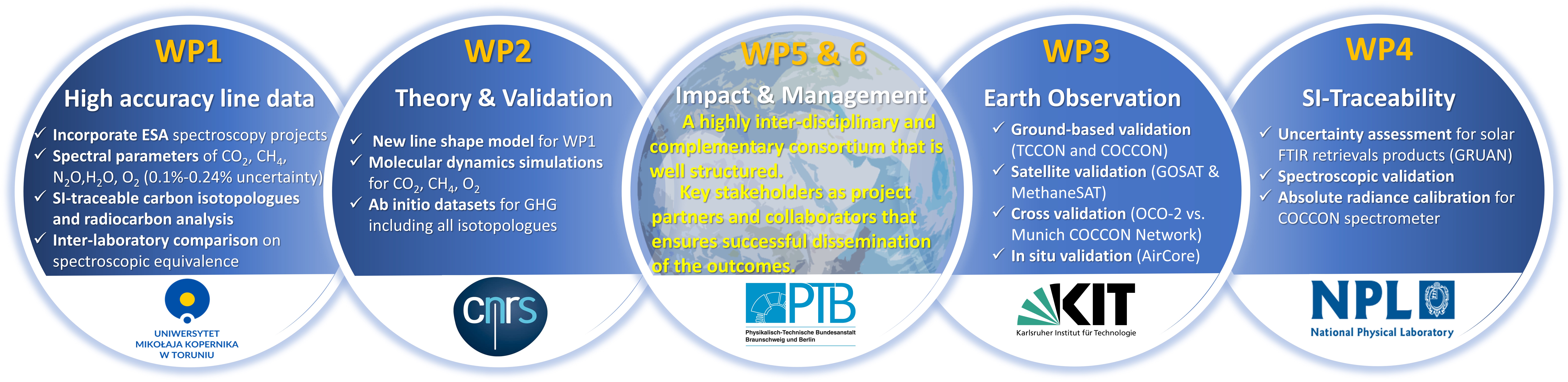
The aim of this work package is to provide accurate line data for improving the accuracy (targets of 0.1 %‑0.24 % on essential line parameters) and SI-traceability through spectroscopic equivalence and comparability of the remote sensing retrievals of CO2, CH4, N2O, and their leading isotopologues, O2 for Air Mass, and H2O for GHG satellites observations both in Europe and internationally (IASI-NG, MicroCarb, OCO‑2, GOSAT/-2/GW, MethaneSAT, CO2M), COCCON and TCCON, using the IUPAC recommended Hartmann-Tran (HT) profile. This includes 1.60 µm and 2.05 µm bands for CO2, 1.67 µm, 3.7 µm and 7.9 µm bands for CH4, 2.25 µm, 3.9 µm, 4.5 µm and 7.8 µm bands for N2O, 1.27 µm and 0.76 µm bands for O2. The spectroscopic accuracy targets are 0.1 %-0.24 % on essential line parameters, meeting the stringent requirement for future GHG satellite missions. The line intensity depletion effect which has strong effects on GHG retrievals will be systematically studied. The results will be used to update the Hartmann-Tran profile to account for such effects.
Work Package 2 - Ensuring the consistency of spectra fitting codes used in WP1 for retrieving spectroscopic parameters from measured spectra
The aim of this work package is a) to ensure that the codes used in WP1 to retrieve spectroscopic parameters are consistent, b) to conduct independent theoretical predictions of line intensity depletions for CO2, O2, and CH4 and c) to perform highly advanced ab initio calculations of the line intensities for CO2, N2O, H2O.
The first aim is to ensure that the codes used in WP1 to retrieve spectroscopic parameters are consistent by testing them through a metrological inter-laboratory comparison including measurements such as Fourier‑transform spectroscopy (FTS), comb-assisted cavity ringdown spectroscopy (CA-CRDS), and Cavity mode dispersion spectroscopy (CMDS). The second aim of WP2 is to conduct independent theoretical predictions of line intensity depletions for CO2, O2, and CH4 using Molecular Dynamics Simulations (MDS). The obtained results will be compared and validated against the experimental data from WP1. The third aim of WP2 is to perform highly advanced ab initio calculations of the line intensities for CO2, N2O, H2O and its isotopologues to standardise the new line shape models needed in remote sensing retrievals of GHGs.
Work Package 3 - Specific campaigns to define and calibrate requirements for spectroscopic output to be used for ground-based validation work and spaceborne missions
The aim of this work package is to implement and verify the calibrated spectral parameters in WP1 (CO2, CH4, N20, and O2) using satellite spectra (e.g. IASI, OCO-2, GOSAT/-2), and ground-based solar absorption spectra (e.g. COCCON, TCCON), through the organisation of specific campaigns, network measurements and building numerical tools; and to cross-validate the results by in situ airborne (aircraft, balloon, AirCore) observations. The parameters will be compatible with upcoming GHG satellite missions (e.g. MicroCarb, MethaneSAT, GOSAT-GW, CO2M, IASI-NG).
The aim of task 3.1 is on the specific campaigns to define requirements for spectroscopic output to be used and implemented for ground-based validation work and spaceborne missions. Task 3.2 will implement the calibrated spectroscopic parameters in COCCON processor including verification. Task 3.3: Implementation of calibrated spectroscopic parameters in the RemoTeC satellite code including verification. Task 3.4 will evaluate and validate the calibrated spectroscopic parameters using ground-based atmospheric spectra and AirCore profiles, while Task 3.5 aims on the evaluation of calibrated spectroscopic parameters using GOSAT and GOSAT-2 spectra. Task 3.6 will evaluate the calibrated spectroscopic parameters using MUCCNET spectra and OCO-2 and MethaneSat data. Finally, Task 3.7 will aim to get a mapping of findings from spectroscopy and SI-traceability.
Work package 4 - Assessment and validation of solar FTIR retrieval uncertainties
The aim of this this work package is to assess and validate Solar FTIR retrieval uncertainties. The WP will develop a full uncertainty evaluation of solar FTIR uncertainty sources using metrological traceability and uncertainty assessment tools developed for atmospheric and Earth Observation measurements with particular attention on dominant sources of uncertainty; As a result, to obtain a robust assessment of the impact of carrying out atmospheric column retrievals using the improved/calibrated spectroscopy data in WP3; Additionally, this work package will validate the spectroscopy datasets from WP1 via comparison to the accepted TCCON and COCCON column reference datasets, and carry out further independent validation of datasets against a novel vertical column measurement technique implemented in WP3; work will also be done to establish improved/calibrated solar FTIR measurements (e.g. TCCON, COCCON) using inputs from the project as a reference upper air measurement technique for priority ECVs and to identify the dominant sources of uncertainty in the final data products for future improvements. Finally, SI traceability will be established for the radiance response of solar FTIR instrumentation through radiative calibration using ultra-high temperature blackbodies.
Work Package 5 - Creating Impact
To share the findings of the project, WP 4 includes building a stakeholder community, maintaining the website, sending out an annual newsletter, inform the scientific and general public via social media, being involved in standardisation activities (contact with standards bodies and committees)as well as scientific discussion at cinferences etc., staff exchanges, and organising stakeholder workshops.
Work Package 6 - Management and coordination
The project will be managed on a day-to-day-basis by the dedicated coordinator from PTB, Dr. Gang Li. The project manager will be supported by the project management board (PMB) consisting of the coordinator and the work package leaders who will act as official delegates from each work package.
WP1 lead: Prof. Roman Ciuryło (UMK)
WP1 co-lead: Dr Manfred Birk (DLR)
WP2 lead: Dr Ha Tran (CNRS-LMD)
WP3 lead: Dr Frank Hase (KIT)
WP3 co-Lead: Prof. André Butz (UHEI)
WP4 lead: Dr Tom Gardiner (NPL)
WP4 co-lead: Dr Marc Coleman (NPL)
WP5 & WP6 Lead: Dr Gang Li (PTB)
WP5 & WP6 co-Lead: Dr Rainer Stosch (PTB)