
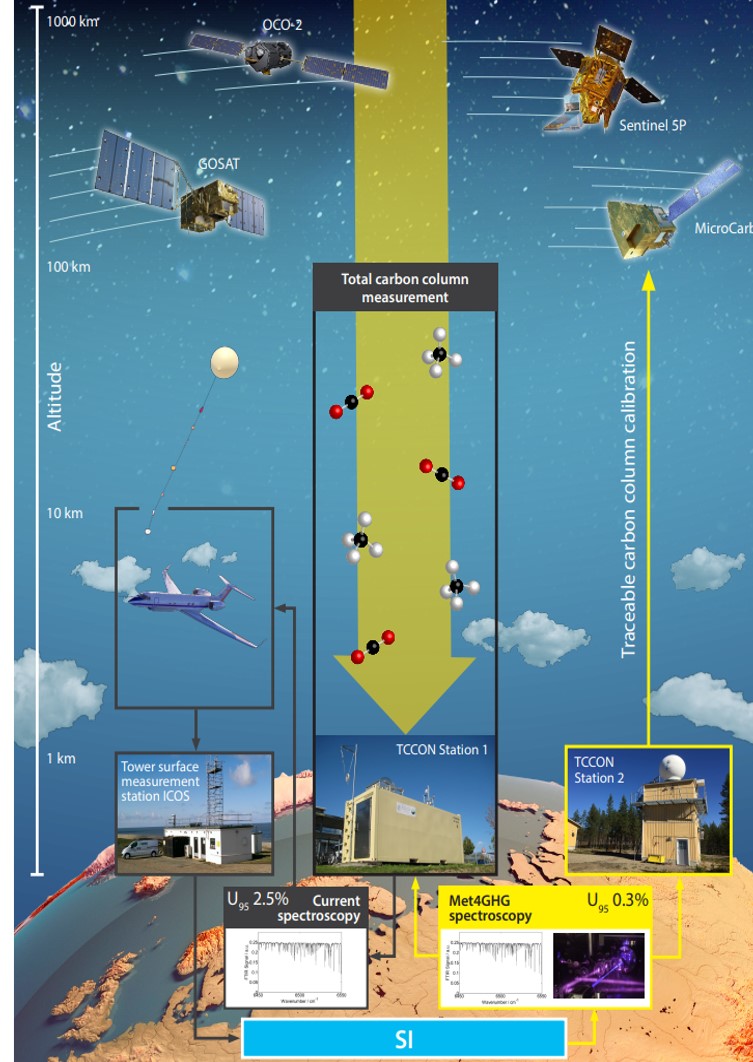
MetCTG overview
Satellite remote sensing of global greenhouse gas (GHG) concentrations provides invaluable information on GHG sources and sinks, supporting efficient climate mitigation policies. Recently, the accuracy targets of upcoming GHG satellite missions (e.g. CO2M) have become increasingly stringent (e.g., 2 ppb of mixing ratio of CH4 (XCH4) and 0.5 ppm of XCO2).
MetCTG project will greatly improve the accuracy of underlying spectral line parameters for satellite GHG retrievals and validate this accuracy with AirCore and ground-based observations.
MetCTG will establish traceability to the SI and improve data comparability and trustworthiness among GHG satellite missions. Furthermore, it will generate equivalence among ground-based sites, and considerably reduce costs on aircraft calibrations.
Objectives
The overall objective of the project is to develop metrology for observations of atmospheric greenhouse gases that satisfy the high accuracy requirements of the European and international remote sensing community, facilitating the identification of sources and sinks of GHGs.
The specific objectives of the project are:
-
To build the foundation for spectroscopic equivalence and comparability among various GHG satellite observations both in Europe and internationally (IASI-NG, MicroCarb, OCO-2, GOSAT/‑2/GW, MethaneSAT, CO2M). This will be achieved by greatly improving the precision and accuracy of spectral line data for the most important anthropogenic GHGs: CO2, CH4, N2O, and their leading isotopologues, O2 for Air Mass determination, and interference H2O features. This includes 1.60 µm and 2.05 µm bands for CO2, 1.67 µm, 3.7 µm and 7.9 µm bands for CH4, 2.25 µm, 3.9 µm, 4.5 µm and 7.8 µm bands for N2O, 1.27 and 0.76 µm bands for O2. The spectroscopic accuracy targets are 0.1 %- 0.24 % on essential line parameters, meeting the stringent requirement for future GHG satellite missions (WP1).
-
To ensure the accuracy, reliability, and comparability of the above-measured spectral line data through metrological inter-laboratory comparisons. Measurements include multiple techniques such as Fourier-transform spectroscopy (FTS), comb-assisted cavity ringdown spectroscopy (CA-CRDS), and Cavity mode dispersion spectroscopy (CMDS). The homogeneity of the measured spectral line intensity will be compared to highly advanced ab initio calculations. Moreover, molecular dynamics simulations (MDS) will be performed and compared to spectral measurements for the investigation of the recently found line intensity depletion effects. The findings will be used to standardise the new line shape models needed in remote sensing retrievals of GHGs (WP2).
-
To calibrate and validate current GHG satellite missions (OCO-2, GOSAT/-2) and prepare for upcoming ones (e.g. MicroCarb, MethaneSAT, GOSAT-GW, CO2M, IASI-NG) by a) applying the improved spectroscopic datasets in selected satellite (such as IASI, GOSAT, OCO-2) retrievals of greenhouse gases (CO2, CH4, N2O) and O2 that are derived from objectives 1 & 2; b) organising specific campaigns, network measurements and building numerical tools; c) combining ground‑based (e.g. COCCON, TCCON), airborne (aircraft, balloon, AirCore) and satellite observations (WP3).
-
To evaluate the uncertainty of retrieval products using metrological traceability and uncertainty assessment tools developed for atmospheric and Earth Observation measurements to ensure comparability among different datasets and identify the dominant sources of uncertainty in the final data products leading to prioritised steps for future improvements (WP4).
-
To facilitate the uptake of improved spectroscopy and satellite observations by the European and international spectroscopy databases (HITRAN, GEISA), satellite remote sensing community (ESA, NASA) and environmental monitoring and regulatory agencies (e.g. GRUAN, WMO). To strengthen the synergy between the metrology and climate science communities within Europe and worldwide, under the auspices of the CIPM Sectorial Task Group on Climate Change and Environment (CIPM‑STG-CENV) and EMN Climate and Ocean Observation.